Where to see cetaceans in the mediterranean
On our whale and dolphin watching expeditions, we set sail from the port of Palamós or Mallorca and leave the coast behind to head towards the north of the Western Mediterranean — areas such as the Gulf of Lion, Liguria, and the northern Balearic Sea.
These waters are special because:
- they have greater depth
- there are nutrient upwellings driven by currents: the Atlantic current, which enters the Mediterranean through Gibraltar and is colder, circulates along the seabed towards the submarine canyons and vertical walls formed on the continental slopes of the Gulf of Lion and Liguria. There, it surfaces, dragging an infinity of nutrients. With the summer sunshine, photosynthesis processes these nutrients and transforms them into life: phytoplankton and zooplankton.
- an ecosystem is formed where food and, with it, life abound.
It is there where the chances of encountering cetaceans increase significantly.
WHAT SPECIES DO WE USUALLY FIND?
Striped dolphins
Stenella coeruleoalba
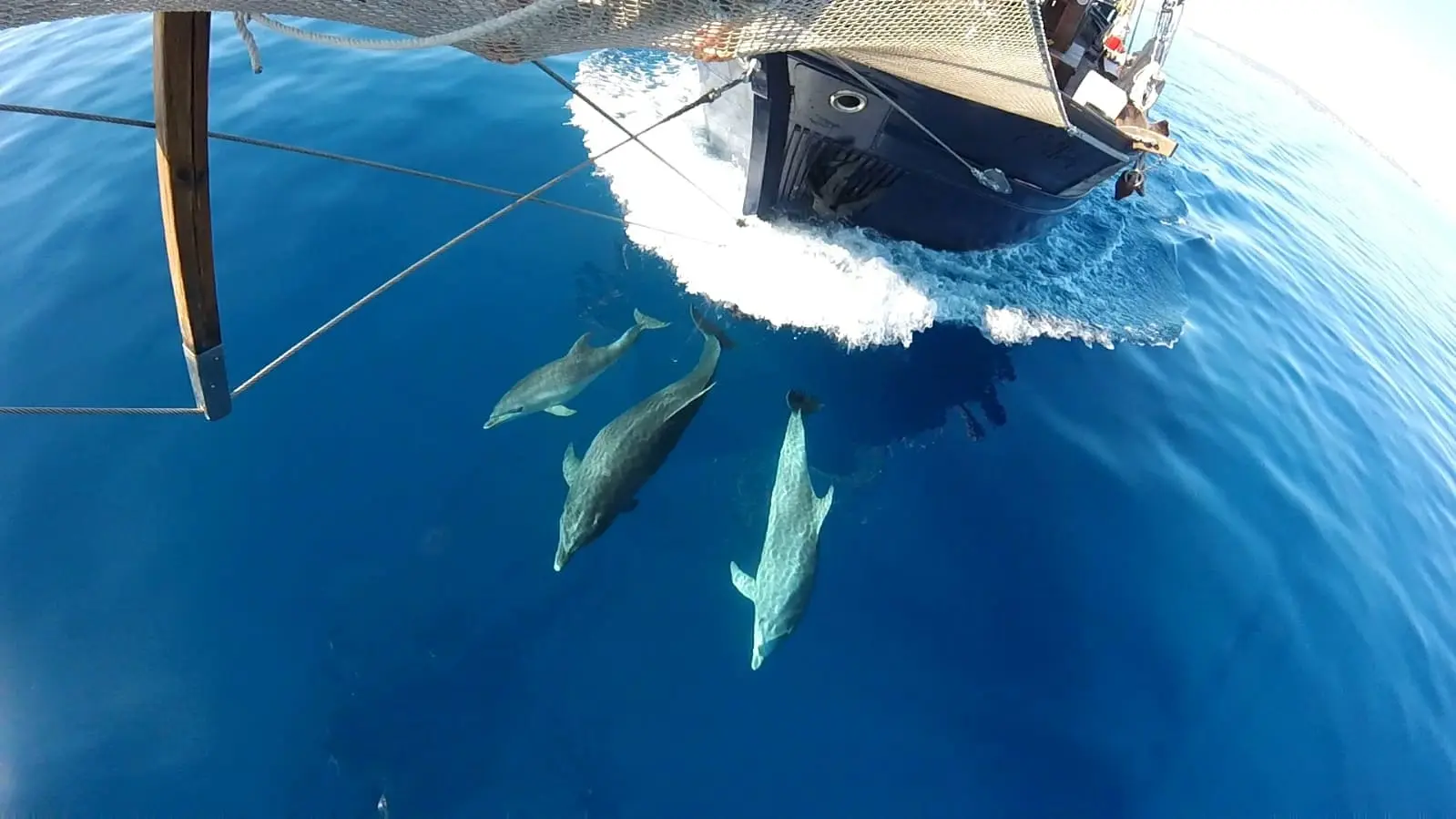
Sleek body with dark lines running along its flanks, which gives it its name. It is fast, active, and usually moves in large pods, leaping and riding the boat’s bow wave.
Common dolphins
Delphinus delphis
Sleek body with an hourglass pattern on its sides (yellow and light grey). It features an elongated and slender snout.
Sperm whales
Physeter macrocephalus
Recognizable by its enormous square head (which occupies nearly a third of its body) and its wrinkled skin.
Pilot whales
Globicephala melas
With a dark and robust body, featuring a highly characteristic rounded dorsal fin. It moves in closely-knit family groups, displaying calm behavior at the surface.
Fin whales
Balaenoptera physalus
The second-largest animal on the planet. It has an elongated and sleek body, with a dark grey back and a whitish belly. Its massive body emerges slowly before disappearing, showing its fluke to dive back down into the depths.
The variety makes every outing distinct and exciting. In addition to the main species, we also find beaked whales, sea turtles, bottlenose dolphins, sunfish, and tuna...
If you are interested in learning more, I have compiled all the details and fun facts about the species we have encountered into a special document.
Download Species BrochureWhen do I have the best chances
This is what I have observed from the deck of the Verdera:
1. Calm sea days
When the water surface is flat, it is much easier to spot movements or signs in the distance.
2. Use of binoculars
Spotting a fin or a blow far away breaks the monotony of the horizon and marks the beginning of something special.
3. No fixed route
We do not have strict routes. The skipper chooses the course based on sea conditions, wind, and our intuition of what might lie ahead.
A REAL DAY ON THE EXPEDITION
Sailing aboard the Rafael Verdera is unique, and I recommend it to everyone. When the day begins, wind and sea conditions as well as the weather are reviewed, and the navigation is planned.
During the crossing, the goal is to sail through areas of the Mediterranean where conditions favor the presence of cetaceans. There are always lookout shifts on deck, keeping an eye on the horizon to spot spouts, movements, or any signs on the surface.
We all collaborate with the ship’s tasks, both in maneuvers and watches, and we participate in preparing the meals.
And we fish too!
But the most exciting part is when someone spots a cetacean. It is amazing to be able to approach them without disturbing them or interfering with their behavior.
The day passes between sailing, looking out, and life on board, usually ending with the sunset, dinner on deck, and resting.